[section separator="true"]
[section-item 6]
[row]
[column 12]
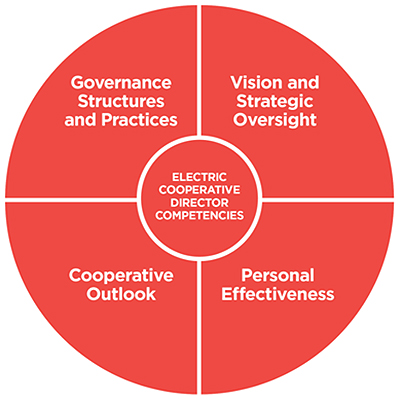
NRECA is committed to helping electric cooperative directors meet the learning challenges of a rapidly changing industry–inside and outside the boardroom. To help identify the knowledge, skills and abilities needed to govern effectively, we’ve developed a competency framework specifically for electric cooperative directors.
[/column]
[/row]
[/section-item]
[section-item 6]
[row]
[column 12]
[/column]
[/row]
[/section-item]
[/section]
Governance Structures and Practices
Ensures the practice of good governance.
[accordions]
[accordion title="Protocol%20and%20Practices"]Engages in activities that support the board in determining its own priorities and information needs.
Board Key Behaviors
| Board Chair Key Behaviors
|
- Regularly participates in board discussions.
- Contributes items to the board agenda when appropriate.
- Applies the seven cooperative principles to decision-making and interactions with membership.
- Recognizes the purpose and value of parliamentary procedure.
- Engages in civil, respectful and constructive dialogue with fellow boardmembers, the CEO, staff and other agents of the board.
- Engages in strategic discussions rather than operational ones; recognizes that the board provides goals and parameters for results, but is not involved with the specific ways they are being achieved.
| - Keeps the board focused on the board agenda.
- Leads the board in its governance functions.
- Ensures proper use of parliamentary procedure.
- Enforces the cooperatives policies, bylaws, legal practices, and code of ethics.
- Works to ensures a common understanding among directors of the cooperative’s goals and strategies and guides the board to work together to achieve those goals.
- Ensures the recruitment, orientation, and development new board members.
|
[/accordion]
[accordion title="Policy%20Development"]Establishes policies that provides guidance and sets expectations for performance.
Board Key Behaviors
| Board Chair Key Behaviors
|
- Demonstrates familiarity with the cooperative's governing policies.
- Distinguishes between governing and operating policies.
- Recognizes the importance of regular policy review in light of changing technology, regulations, legal requirements, member preferences, etc.
| - Ensures regular review of governance policies, practices, legal requirements, and code of conduct.
- Collaborates with the cooperative's attorney to make certain policies are not in conflict with articles of incorporation, bylaws, state and federal laws.
|
[/accordion]
[accordion title="Board%20Accountability"]
Monitors board operations and takes responsibility for board actions and result.
Board Key Behaviors
| Board Chair Key Behaviors
|
- Recognizes the board's responsibility to oversee its own performance.
- Performs due diligence on issues important to the long-term success of the co-op.
- Maintains confidentiality of boardroom deliberations.
- Demonstrates ethical behavior and legal compliance.
- Recognizes the value of diversity of age, race, gender, and thought in thecomposition of the board and the recruiting of director candidate.
| - Ensures a clear charter is drafted for all board committees.
- Initiates and oversees the board performance assessment processes.
- Holds self and others accountable to the same standards of analysis, results, and consequences.
|
[/accordion]
[accordion title="Board%2FManager%20Relationship"]Builds a civil, constructive,mutually respectfulrelationship with the CEO.
Board Key Behaviors
| Board Chair Key Behaviors
|
- Asks questions and requests information of management to fulfill risk oversight responsibilities.
- Recognizes the roles and responsibilities of board officers.
- Distinguishes between the board's role and that of the CEO.
- Applies appropriate processes and tools for CEO appraisal and compensation.
- Maintains a "healthy skepticism" of management proposals.
| - Initiates and oversees the CEO appraisal processes.
- Serves as the point of contact for board members on requests for information from management.
- Ensures the creation of a "delegation of authority" policy (job description) for the CEO specifying the board's expectations for what roles have been delegated to the CEO, as well as the cooperative's culture and values.
- Ensures that the board speaks with "one voice" to the CEO.
- Ensures that directors and officers understand their respective roles.
- Acts as a sounding board for the CEO regarding emerging issues, strategies or potential problems.
- Ensures that the CEO performance criteria and compensation are aligned with the strategic plan and key objectives.
|
[/accordion]
[/accordions]
Vision and Strategic Oversight
Executes board oversight responsibilities.
[accordions]
[accordion title="Analytical%20Thinking%20and%20Decision%20Making"]
Thinks systematically, conceptually, and analytically to determine effective solutions.
Board Key Behaviors
| Board Chair Key Behaviors
|
- Demonstrates ability to analyze reports and formulate questions on information provided.
- Maintains awareness of the organization’s values and goals while engaged in discussion regarding actions or decisions.
- Recognizes the difference between strategic and tactical decisions.
- Demonstrates the ability to understand issues from different perspectives.
- Avoids jumping to conclusions based on personal bias, historical solutions, or narrow perspectives.
- Formulates specific, measurable and achievable goals.
- Exercises prudent business judgment in making decisions, that is, acts on an informed basis, in good faith and with the honest belief that the decision is in the best interests of the cooperative.
| - Ensures discussions are made in a timely manner.
- Moves the board towards consensus.
- Focuses on arriving at a specific, actionable, clearly formulated decisions.
- Ensures each director has opportunity to contribute his/her ideas analysis, wisdom and experience to discussion.
|
[/accordion]
[accordion title="Strategic%20Planning"]
Engages in strategic planning that contributes to the direction, core values and goals of the cooperative.
Board Key Behaviors
| Board Chair Key Behaviors
|
- Actively engages in the strategic planning process.
- Recognizes the board’s role in thinking strategically about the cooperative’s future.
- Seeks to understand the cooperative’s business and operating environment to contribute to the strategic discussions.
- Brings independent and objective thinking to strategic planning.
- Analyzes the cooperative’s strengths, weaknesses, opportunities, and threats.
- Balances short-term needs with long-term and changes to industry, technology and membership demographics.
| - Keeps board work focused on the cooperative’s mission, vision, and strategic direction.
- Keeps the board in focusing on strategy and risks.
- Leads the board in the identification and common understanding of measures of success for each strategic initiative.
- Ensures participation in the strategic planning process by all directors.
|
[/accordion]
[accordion title="Risk%20Management%20and%20Oversight%20"]
Forecasts and evaluates a variety risks and identifies strategies to avoid or mitigate their impact.
Board Key Behaviors
| Board Chair Key Behaviors
|
- Recognizes the value and benefits of enterprise risk management; links the concept of enterprise risk management with the board’s strategic planning process.
- Distinguishes the board’s oversight role from management’s role in risk management.
- Prioritizes risks.
- Defines risk appetite and risk tolerance.
- Takes a long-term view (5-7 years) of risks that lie ahead for the cooperative and develops strategies to address top priorities.
- Recognizes the key areas of risk to the cooperative and determines strategies to avoid, reduce, transfer, or accept the risk.
| - Ensures the board's fulfillment of its risk oversight responsibilities.
- Ensures the board has established and communicated to management clear risk appetite and tolerance.
- Leads the board to come to consensus on a risk oversight model.
- Ensures that enterprise risk management is linked with the board’s strategic planning process.
|
[/accordion]
[accordion title="Financial%20Oversight"]
Demonstrates an appropriate level of financial knowledge and understanding and can interpret financial reports ands tatements, and monitor corrective action to ensure financial goals.
Board Key Behaviors
| Board Chair Key Behaviors
|
- Lead the board in financial oversight and stewardship.
- Understands basic financial concepts and how to analyze financial statements.
- Demonstrates ability to use the cooperative’s strategic plan, annual budget and other business plans to effectively monitor results and variances.
- Understands the factors that contribute to and must be balanced with regards to equity management, capital credit, rate design and debt structure decisions.
| - Leads in financial oversight and stewardship.
- Monitors and assesses the board’s understanding and application of financial concepts and policies; seeks clarification and education for the board when appropriate.
- Ensures that the board conducts sufficient oversight and discussion on recommended strategies.
- Leads the board in coming to consensus on a financial policy.
|
[/accordion]
[/accordions]
Cooperative Outlook
Demonstrates the principles of the cooperative business model.
[accordions]
[accordion title="Industry%20Principles%20and%20Concepts"]
Knows the basic jargon and concepts of the energy industry.
Board Key Behaviors
| Board Chair Key Behaviors
|
- Seeks to understand industry terminology.
- Recognizes the opportunities and risks of changing technologies, market structures and demographics.
- Recognizes the value of diversity within the power supply portfolio.
- Knows state and federal electric utility requirements.
| - Ensures new board members receive an orientation to the industry.
- Encourages directors to seek opportunities to enhance their understanding of the industry and their fiduciary responsibilities.
- Demonstrates a "big picture" persepctive on issues related to the electric cooperatives, including the forces and factors impacting the industry.
|
[/accordion]
[accordion title="Cooperative%20Principles%20and%20Practices"]
Demonstrates an appreciation of the cooperative buisness model and a commitment to cooperative values.
Board Key Behaviors
| Board Chair Key Behaviors
|
- Demonstrates understanding of the cooperative business model.
- Models cooperative principles and values in own behavior both inside and outside the cooperative.
- Defends and stands up for the cooperative’s values, vision and objectives.
- Displays personal humility and promotes the success of the cooperative above promoting self.
| - Builds commitment to integrating cooperative principles and practices into board processess and decisions.
|
[/accordion]
[accordion title="Community%20Engagement%20and%20Communication"]
Places the cooperative in a collaborative position for maintaining and growing healthy communities.
Board Key Behaviors
| Board Chair Key Behaviors
|
- Recognizes the importance of the cooperative’s connection to the communities it serves.
- Differentiates between the communication roles and responsibilities of directors and cooperative staff.
- Acts as an ambassador for the cooperative through personal involvement in community activities; engages in the cooperative's grassroots advocacy.
- Communicate positive outcomes achieved as a result of board decisions and overall effectiveness.
- Demonstrates comfort in handling "on the street" member interactions including when to refer questions to the CEO.
| - Speaks to small and large groups with a professional demeanor.
- Ensures the creation of a comprehensive communications policy.
- Equips the board to communicate effectively in the community.
|
[/accordion]
[accordion title="Member%20Focus"]
Focuses on the needs of members.
Board Key Behaviors
| Board Chair Key Behaviors
|
- Views members as owners; is proactive in anticipating their current and potential needs.
- Seeks to recognize member diversity in decision-making.
- Dedicated to meeting the needs and expectations of members.
| - Demonstrates responsiveness to member requests.
- Models the treatment of members as owners, and is proactive in anticipating their current and potential needs.
|
[/accordion]
[/accordions]
Personal Effectiveness
Interacts respectfully with different individuals and groups.
[accordions]
[accordion title="Interpersonal%20Communications%20"]
Listens, relates and expresses oneself in a manner that is effective while supporting mutual understanding.
Board Key Behaviors
| Board Chair Key Behaviors
|
- Demonstrates commitment to information sharing and a culture of inquiry within the board room.
- Communicates ideas clearly, factually and concisely.
- Listens respectfully to others’ ideas and opinions and asks questions to understand others’ point of view.
| - Demonstrates restraint and encourages participation and opportunities for collective exploration.
- Encourages the contribution of all directors in deliberations.
- Listens to, observes, and learns about individual directors' interests, concerns, motivations and boardroom culture as a whole.
|
[/accordion]
[accordion title="Self-Awareness%20%2F%20Continual%20Learning"]
Demonstrates an ongoing commitment to learning and self-improvement.
Board Key Behaviors
| Board Chair Key Behaviors
|
- Demonstrates self-awareness into own emotional strengths, weaknesses.
- Listens to constructive feedback and incorporates suggestions.
- Takes advantage of opportunities to learn more about the cooperative, the electric cooperative network and the electric industry.
- Keeps up to date on new developments by reading cooperative publications, industry news and other resources.
- Maintains curiosity and motivation to learn.
- Demonstrates self-awareness of areas for self improvement and development.
- Demonstrates self awareness of personal body language.
| - Champions continuous learning within the board regarding the innovations in governance structures and how they can be incorporated into the cooperative’s governance philosophy.
- Encourages on-going education among directors and further development of competencies.
- Seeks feedback on performance.
- Watches others for their reaction to his/her attempt to influence and adjusts as needed.
- Models the ability to learn quickly in the face of new information or changing circumstances.
|
[/accordion]
[accordion title="Flexibility"]
Remains open to new ideas, information and approaches.
Board Key Behaviors
| Board Chair Key Behaviors
|
- Demonstrates flexibility and adapts to change.
- Maintains ability to focus on cooperatives’ goals and objectives while shifting mindset to incorporate new information or changed circumstances.
- Listens to ideas, different approaches of others and is comfortable letting go of “we have always done it this way.”
| - Encourages board to explore new and different ways of accomplishing the cooperative's objectives.
- Facilitates exploration of successes and failures for ideas for improvement.
- Models the ability to transition comfortably between situations.
|
[/accordion]
[accordion title="Builds%20Relationships%20and%20Influences%20Others"]
Creates and fosters constructive working relationships; Persuades others towards an outcome consistent with the organization’s goals.
Board Key Behaviors
| Board Chair Key Behaviors
|
- Understands the dynamics of internal and external relationships and works to persuade and motivates others.
- Identifies opportunities to positively influence others.
- Maintains composure at all times.
- Leads by example and sets standards for professional behavior as an ambassador of the cooperative.
| - Fosters a collaborative environment.
- Uses expertise and business experience to influence and maximize outcomes.
- Articulates positions in a way that inspires others to support decisions or actions by using facts, logic, and emotional factors.
- Recognizes the social components and human dynamics that exist in a boardroom between and among directors, CEO, and the co-op’s advisors.
|
[/accordion]
[accordion title="Negotiation%20and%20Conflict%20Resolution"]
Manages and resolves conflicts and disagreements in a constructivive manner.
Board Key Behaviors
| Board Chair Key Behaviors
|
- Resolves differences in ways that build trust and confidence.
- Uses active listening skills to understand disagreements.
- Demonstrates and encourages empathy so that all sides can understand each other’s perspectives.
| - Facilitates conversations that generate solutions to conflict or friction points.
- Negotiates through potential conflict situations to avoid triggering disputes.
- Mediates disputes by identifying and gaining commitment to mutually agreeable resolutions.
- Maintains composure in face of heated debates or adversity.
|
[/accordion]
[accordion title="Respect%20and%20Appreciation%20of%20Differences"]
Leverages the unique talents of each person and promotes respect of individual differences among board members.
Board Key Behaviors
| Board Chair Key Behaviors
|
- Develops and nurtures a respectful atmosphere in the boardroom that leverages the talents of each person and promotes cultural awareness among directors.
- Recognizes and communicates the value of diverse perspectives.
- Engages in collaborative and mutually beneficial working relationships with people regardless of their individual differences.
- Recognizes and appreciates generational differences among directors.
- Champions policies, procedures and values that encourage awareness and acceptance of individual differences.
- Helps to foster an environment of respect in the boardroom.
| - Helps others increase their awareness and acceptance of individual differences.
- Demonstrates humility.
- Ensures fair treatment of all.
- Models respectful behavior by effectively engaging with people different from him/herself.
|
[/accordion]
[accordion title="Integrity%20and%20Courage%20"]
Makes decisions and acts consistently with values, professional standards, and the broader interests of the cooperative.
Board Key Behaviors
| Board Chair Key Behaviors
|
- Makes decisions and acts consistently, ethically, and transparently and with the values, standards, and broader interests of the cooperative.
- Thinks independently.
- Presents truthful information in an appropriate and helpful way.
- Is trusted to keep confidences.
- Acts in ways that put the cooperative’s interests above personal needs and goals.
- Stands up for what is right and take personal responsibility for mistakes.
| - Models, articulates, and upholds the rules of conduct that are outlined in the board policies.
- Embodies the spirit of the cooperative and continually keeps the integrity and goals of the cooperative at the forefront of every decision.
- Handles interpersonal problems quickly and directly, while focusing on the behavior, not the person.
- Gains and maintains trust by being truthful, fair and consistent.
|
[/accordion]
[/accordions]
Download this
competency map (PDF) that shows how NRECA learning offerings align with NRECA's Electric Cooperative Director Competencies.
For information about using competencies for identifying learning needs and selecting education:
Danielle Jackson, Manager, Education Programs
703-907-6367
Danielle.Jackson@nreca.coop
Take the director online assessments to identify your professional development needs:
[button title="Director%20Education%20Online%20Assessment" link="%2Fconferences-education%2Fcertificates%2Fdirector-certificate-programs-overview%2FPages%2FSecure%2FAssessment-New%2FAssessment-Introduction.aspx" /]