The following information provides explanation about FERC Order 2222 and related considerations for electric cooperatives.
[accordions]
[accordion title="What%20Is%20FERC%20Order%202222%3F"]Issued by the Federal Energy Regulatory Commission in September 2020, Order 2222 and progeny
1 require wholesale electricity markets, operated by Regional Transmission Organizations (RTOs) and Independent System Operators (ISOs), to allow aggregated distributed energy resources (DER) to participate in the wholesale markets. Order 2222 expands the types and configurations of resources that RTOs and ISOs must accommodate in wholesale energy, capacity, and ancillary services markets, including heterogenous aggregations of small-scale assets, solar panels, batteries, electric vehicles, smart thermostats, and demand response, can compete directly alongside traditional generation in energy.
Order 2222 requires RTOs/ISOs to revise their tariffs to allow DER aggregators to register and compete in wholesale energy, capacity, and ancillary services markets, subject to the same fundamental bidding and participation rules as other market participants providing equivalent services.
[/accordion]
[accordion title="Definition%20of%20DER%20under%20Order%202222"]
“DERs are small-scale power generation or storage technologies (typically 1 kW to 10,000 kW) that can provide an alternative to or enhancement of the traditional electric power system. These can be located on a utility’s distribution system, a subsystem thereof, or behind the customer meter — including electric storage, distributed generation, demand response, energy efficiency, thermal storage, EVs, and EV supply equipment.” - FERCThe minimum aggregation threshold is 100 kW. RTOs/ISOs must propose a maximum size or explain why one is unnecessary.
This
means a single commercial or industrial facility of that size could potentially
participate on its own, and smaller distributed devices, batteries, EV chargers, and/or smart thermostats,
can be bundled together by a cooperative or a third-party aggregator to reach
that threshold. [/accordion]
[accordion title="What%20Should%20Cooperatives%20Be%20Aware%20Of%3F"]With several RTO markets either up and running or scheduled to go live as 2
nd quarter 2026, cooperatives should be aware of three key considerations: where their market falls in the implementation timeline, whether recent load growth has affected their eligibility for the small utility exemption, and whether third-party aggregators may seek to enroll member DERs in their service territory. All three are addressed below.
[divider styles="solid" style="solid" /]
[simples-list color="primary" separator="line" separator-color="primary-light"]
[simple-list-item title="Deadlines%20are%20approaching.%20" description="ISO-NE%20and%20NYISO%20go%20live%20in%20late%202026.%20PJM%20follows%20in%202028.%20CAISO%20is%20already%20fully%20implemented." /]
[simple-list-item title="Load%20growth%20has%20increased.%20" description="Data%20centers%20and%20industrial%20growth%20have%20raised%20total%20sales%20for%20some%20co-ops%2C%20in%20some%20cases%20approaching%20the%204%20million%20MWh%20threshold%2C%20at%20which%20point%20co-ops%20are%20no%20longer%20eligible%20for%20the%20small%20utility%20exemption%20discussed%20below.%E2%80%99" /]
[simple-list-item title="Third-party%20aggregator%20activity%20may%20increase.%20" description="Third-party%20aggregators%20may%20target%20large%2C%20flexible%20loads%20in%20cooperative%20territory." /]
[/simples-list]
[/accordion]
[accordion title="The%20Small%20Utility%20Exemption%20and%20the%20Potential%20Impact%20of%20Load%20Growth"]Under Order 2222, a cooperative's exposure to third-party aggregator activity is directly tied to how many MWhs it sells annually. The rule prohibits grid operators from accepting bids from the aggregation of customers of small utilities whose electric output was 4 million MWh or less in the preceding fiscal year, unless the relevant retail regulatory authority (RERRA) for a small utility affirmatively allows such participation.
[1] Most distribution electric cooperatives currently fall below this threshold. However, with large load additions like data centers becoming more common, cooperatives that have previously relied on this exemption should reassess whether they continue to qualify. Even a single data center with roughly 5–100+ MW of demand
[2]operating at a high load factor could push a utility with approximately 3 million MWh of annual sales above the 4 million MWh threshold.
[/accordion]
[accordion title="Third-Party%20Aggregator%20Activity"]Aggregators under Order 2222 may be
affiliated with utilities or independent entities, as
long as
they meet RTO/ISO participation requirements. This
means a cooperative may be required to coordinate with, and share operational
data with, an aggregator it did not invite and does not control. The
cooperative’s role in this process is defined but limited: it may review
enrollments, raise safety and reliability concerns, and flag operational
issues, but it does not have the authority to broadly prohibit aggregator
participation. Cooperatives should familiarize themselves with their RTO’s
specific enrollment and coordination procedures as implementation deadlines
approach. [/accordion]
[accordion title="How%20DER%20Aggregations%20Work"]
The diagram above provides an example of how DER aggregations can work in practice. To the left of the diagram is a single component DER, presumably relatively small in output, such as a solar panel, electric storage, or electric vehicle charging equipment. In the middle box, such resources are brought together by a DER aggregator who ensures that the aggregation or bundle of DER resources is large enough to meet the market rules. Operating as a combined unit, this aggregation becomes the direct market participant. The DER component provides energy products like megawatts (MW) or megawatt-hours (MWh) to the DER aggregator, who bundles those energy products together and delivers them to the RTO. The money flow for compensation would go in the reverse direction: from the RTO market back to the DER aggregator, and ultimately back to each individual DER and its owner.
[1]
[1] FERC Order No. 2222 Explainer: Facilitating Participation in Electricity Markets by Distributed Energy Resources[i] | Federal Energy Regulatory Commission
[/accordion]
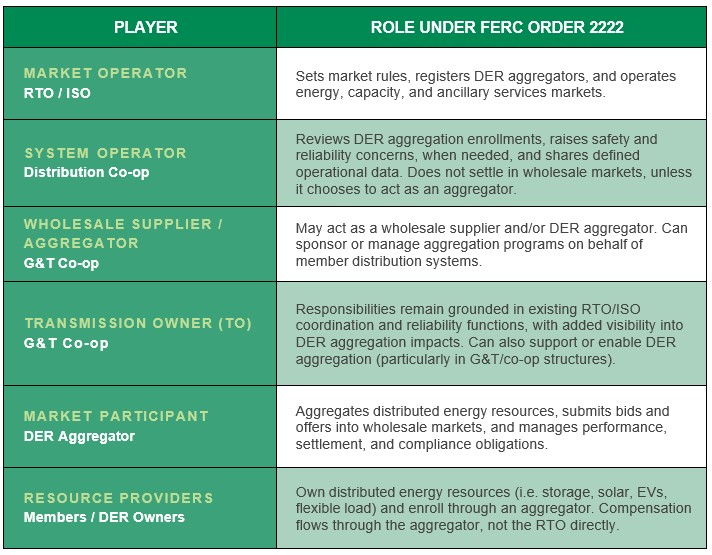
[accordion title="Who%20Plays%20What%20Role%3F"]
[/accordion]
[accordion title="What%20is%20NRECA%20Doing%20Regarding%20FERC%202222%3F"]
Advocating for Our Members
NRECA’s Government Relations actively engaged in FERC’s Order 2222 rulemaking, advocated for cooperative interests and then monitored subsequent compliance filings across markets. GR also developed educational resources to help co-ops understand the overall framework of Order 2222 (see the Resources Toolkit section).
Building Helpful Resources for Co-ops
NRECA’s Business and Technology Strategies (BTS) team is actively developing a suite of cooperative-focused resources on Order 2222, including plain-language explainers, operational guidance, and readiness frameworks. These materials will be added to the Resource Toolkit as they are completed.
Cooperatives with questions are encouraged to reach out directly to NRECA staff contacts below.
[/accordion]
[/accordions]